VERIBIO

VERIBIO

Project Description

Rethinking Verification

An Interdisciplinary Research Project to Strengthen Biological Arms Control
The Biological Weapons Convention has prohibited biological weapons since 1975 – but unlike the nuclear or chemical domain, it still lacks a binding mechanism to verify compliance. An attempt to change this failed in 2001. Only in 2022 did the states parties resume negotiations. VERIBIO picks up exactly here.

Funded by the Federal Ministry of Education and Research under the funding guideline for natural science and technology peace and conflict research.
Duration: 2024–2028.

logo dark

6 Work Packages

4-Year Duration

5 Transfer Partners

2 Universities

INTERDISCIPLINARY RESEARCH

How Technology and Political Science Interlock

VERIBIO's scientific methodology is based on the close integration of digital process monitoring and arms-control policy analysis, enabling up-to-date verification of biological risks.
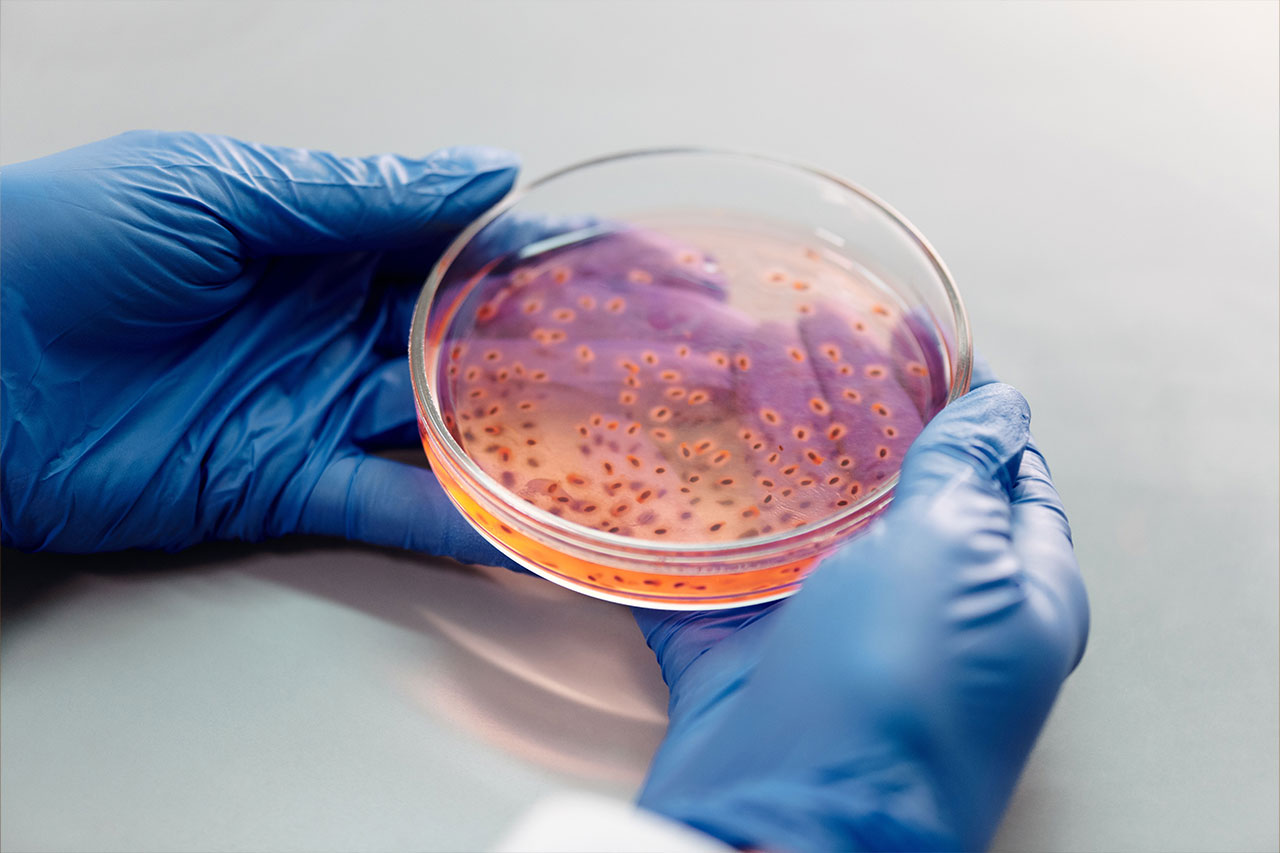
Data-Driven Process Monitoring

The biotechnological research focuses on developing a data-driven early-warning system for industrial facilities.

Political Science Analysis & Arms Control

The technological development is accompanied by a comprehensive analysis of the global arms-control policy framework.

project description
Process & Verification Concept

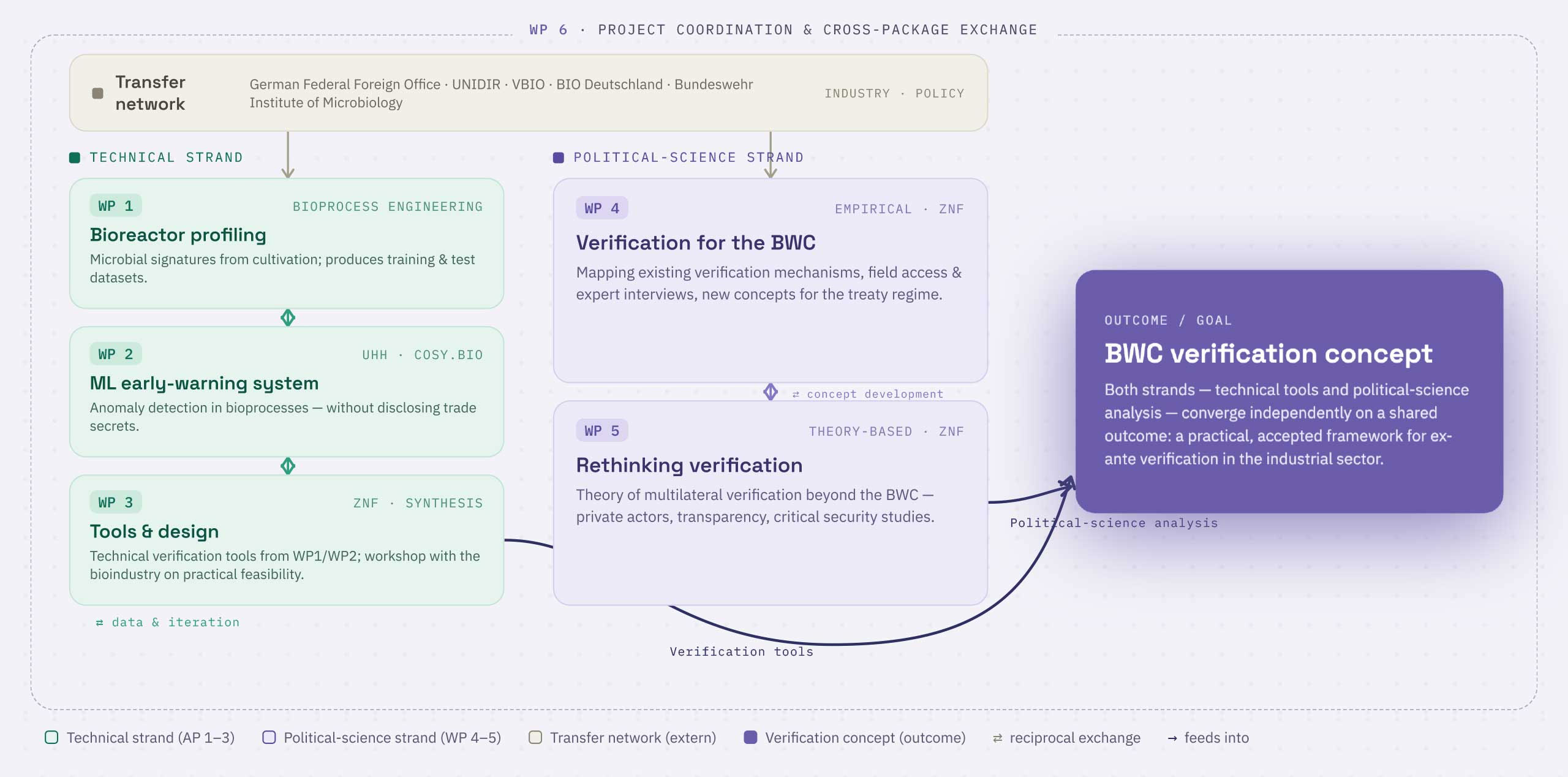
The technical and political science levels are closely interlinked: insights from process monitoring feed into the development of a verification concept – and vice versa.

Rethinking Verification

From Research to Policy Advice

Our findings feed directly into international BWC negotiations – through publications, policy papers and direct exchange with decision-makers.

project description

Six Work Packages, One Shared Goal

To develop a practical and reliable verification model, the project is divided into six complementary work packages. These systematically guide the project from theoretical and historical foundational research through data-driven laboratory practice to final policy transfer.

WP 1 — Building Microorganism Profiles

We investigate how bacteria and yeasts behave when growing in bioreactors – and which process data reveal when a reactor is being misused. This is based on cultivations of E. coli strains and two further microorganisms.

Based on the collected data, an algorithm is developed to detect anomalies in bioprocesses – a prototype for future compliance monitoring that protects trade secrets. (UHH · CoSy.Bio · 43 PM)

We analyse which scientific and technological developments are suitable for BWC verification and, together with industry, develop a practical concept. (UHH · ZNF · 30 PM)

A political science dissertation examines how a verification mechanism could concretely be anchored in the BWC regime – based on historical analyses and expert interviews. (UHH · ZNF · 48 PM)

We are developing a theory of multilateral verification that goes beyond the BWC and includes private and economic actors. (UHH · ZNF · 34 PM)

Organisational management of the entire early-career research group: communication, resources, and training of doctoral researchers. (UHH · ZNF · 5 PM)

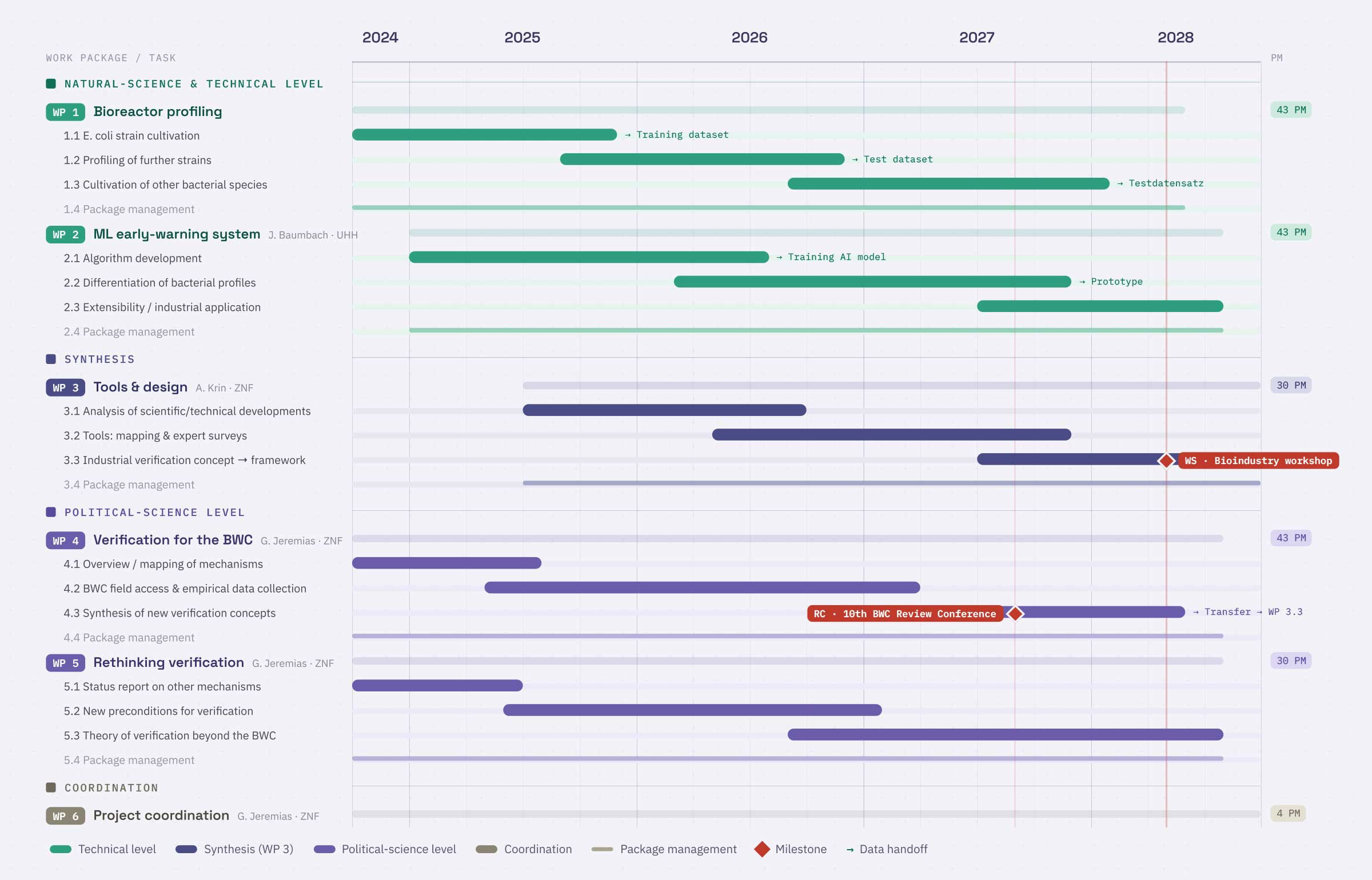
Timeline · 48 Project Months

Timeline 2024–2028

Approximate time allocation of the six work packages across the project duration (Oct 2024 – Sep 2028). Bar lengths follow the phase logic described in the proposal; milestones and data handovers are highlighted.

Scroll to Top